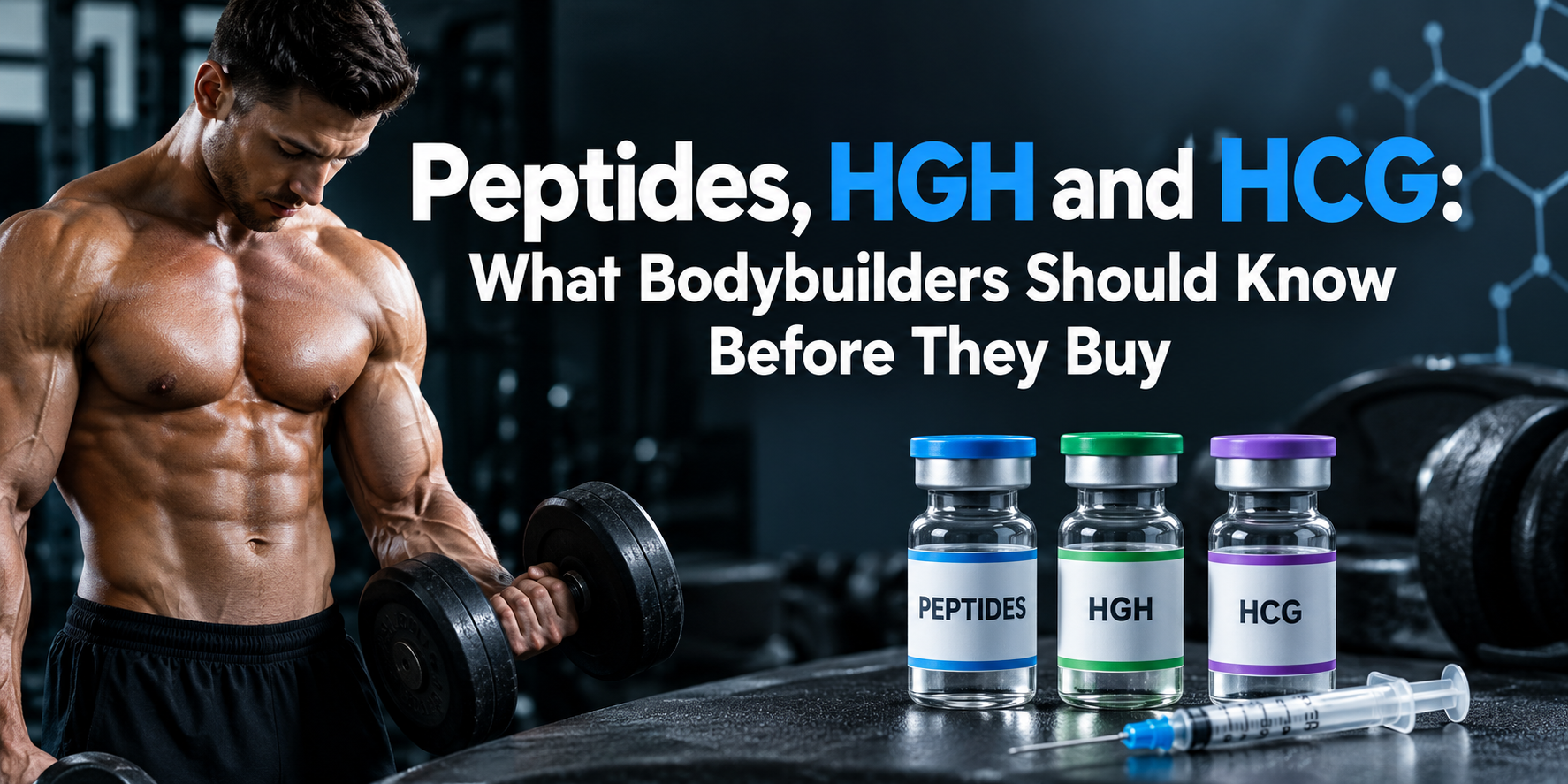
Ask ten bodybuilders about peptides and you will get ten different answers, because the word is used for everything from a cheap research vial to pharmaceutical growth hormone to the HCG people keep for after a cycle. Those products have almost nothing in common. They have different regulatory status, different storage requirements, different price points and completely different supply chains, and treating them as one category is how people end up paying pharmacy prices for a vial that was never refrigerated. This guide separates the three, explains what actually determines quality in each, and covers how to buy peptides online without guessing what is in the box.
Three Categories, Not One
The first thing worth fixing is the vocabulary. Peptides are short chains of amino acids, and the ones that matter here fall into a few families: growth hormone secretagogues such as ipamorelin, CJC-1295 and GHRP-6; repair oriented compounds such as BPC-157 and TB-500; metabolic products such as AOD9604; and a long tail of compounds sold strictly for laboratory work. Growth hormone is different in kind. Somatropin is a recombinant protein of 191 amino acids, and it is a prescription medicine. HCG is different again, a glycoprotein hormone that mimics luteinising hormone. If a seller files all of them under one heading with one shipping policy, that tells you how carefully they know their own stock.
Research Peptides: What You Are Actually Buying
Most peptides sold online carry a research use only label, which is a legal disclaimer as much as a product description. Two things separate a good supplier from a bad one. The first is form: whether the product arrives lyophilised, as a freeze dried powder with a separate vial of bacteriostatic water, or pre mixed. Lyophilised product travels far better and keeps far longer, and a seller shipping pre mixed peptides into a warm climate is telling you something about how they think about storage. The second is documentation: a certificate of analysis with a purity figure measured by high performance liquid chromatography and, ideally, mass spectrometry confirmation of the sequence. A purity percentage with no laboratory behind it is marketing, not evidence. The catalogue should also be specific enough to read. A product grid that lists BPC-157, TB-500, ipamorelin and CJC-1295 by brand, strength and vial count is doing the basic work. A grid that shows a photograph and a price is not.
HGH: Pharma, Generic, and Everything In Between
Growth hormone is the one product in this group where the supply chain is the product. Somatropin is a protein, so it degrades with heat and agitation, and it needs an unbroken cold chain from the manufacturer to your door. The pharmaceutical brands, Genotropin from Pfizer and Humatrope from Lilly among them, are what a pharmacy dispenses, and their packaging, batch coding and pen or vial systems are hard to copy convincingly. Below that sits a large generic market, part of it legitimate and part of it not, and the difference usually shows up as inconsistent batch documentation or a seller who cannot say where the stock was stored. Two questions are worth asking specifically. Is the product the 191 amino acid human sequence rather than the older 192 form? And does the seller ship with cold chain packaging rather than a padded envelope? If you are reading HGH for sale listings, those two answers will tell you more than the price per international unit.
HCG: The Product People Overlook
HCG is not a peptide in the sense the others are, and it is not growth hormone. It is a prescription gonadotropin that mimics luteinising hormone, and in bodybuilding it appears almost exclusively at the end of a cycle, when the goal is restarting the body’s own testosterone production. It normally ships as a lyophilised powder with a separate solvent, because it degrades quickly once it is mixed, which is why the storage instructions on the box matter more here than almost anywhere else in this market. Vials are labelled by international units, from 500 IU up to 10,000 IU, and the manufacturer, the IU figure and the presence of a matching solvent vial are the three things to confirm before you buy HCG online.
How to Tell a Real Supply Chain From a Risky One
Seven checks cover most of it. Cold chain: growth hormone and reconstituted HCG need to stay between 2 and 8 degrees Celsius, so ask how it is shipped rather than whether it is shipped cold. Batch codes and expiry dates that trace back to a manufacturer, printed rather than stuck on. Documentation: a certificate of analysis per batch, not one screenshot reused across a whole catalogue. Origin: domestic warehouse or international dispatch, which changes delivery time and customs risk. Reship and refund terms, stated plainly rather than discovered after something goes wrong. Catalogue specificity: named manufacturer, stated strength, stated vial count on every listing. Payment and privacy: a checkout that treats both as a default rather than a favour.
Storage and Handling After Delivery
Lyophilised peptides hold up best in a freezer or at the back of a refrigerator, away from light. Once reconstituted they belong at 2 to 8 degrees Celsius and are typically used within a few weeks. Growth hormone stays refrigerated and should never be frozen. HCG, once mixed, also stays refrigerated and degrades with time, so a large vial bought for a short window is a false economy. None of these should spend a day in a car, on a window ledge, or anywhere the temperature swings, and that includes the trip home from a parcel locker.
Buying Peptides, Growth Hormone and HCG Online in 2026
This is the part where the storefront matters less than the documentation behind it. A supplier worth using shows the compound, the strength, the vial count and the manufacturer on every listing, prices in a currency you can read, and is explicit about shipping method and warehouse location. If you are comparing peptide catalogues, start with one that separates research compounds by family instead of dropping more than a hundred products into a single grid, because research peptides for sale only means something when you can see what you are buying. The same logic applies to growth hormone, where the IU content and the manufacturer belong on the label, and to HCG, where the listing should get you a lyophilised vial with a matching solvent rather than a single unlabelled ampoule. The sellers who publish that detail are, almost without exception, the ones still trading next year.
Legal and Safety Notes
Growth hormone and HCG are prescription only in the United States, and distributing either without a prescription is a federal offence. Most research peptides are sold for laboratory use and are not approved for human consumption in any form. Several products sold alongside these categories also fall under anabolic steroid law. Everything here is general information rather than medical or legal advice, and the people qualified to advise you on your own situation are a licensed physician and, where it applies, an attorney.
Frequently Asked Questions
Are peptides the same as HGH?
No. Peptides are short amino acid chains, while HGH is a full recombinant protein produced in a laboratory. They are bought, stored and regulated differently, even when the same seller carries both.
Does HGH need to be refrigerated?
Yes. Before and after reconstitution it is stored between 2 and 8 degrees Celsius, and it should never be frozen.
What is the difference between 191aa and 192aa HGH?
The 191 amino acid version is the human sequence. The 192 form was an older synthetic variant associated with a higher rate of antibody formation, and most of what is sold today as a premium product is the 191 sequence.
Is HCG the same as HGH?
No. HCG is a gonadotropin used for hormone recovery after a cycle, while HGH is somatropin. They share an acronym pattern and nothing else.
Why do peptides arrive as a powder?
Lyophilised peptides are far more stable in transit and in storage. Mixing is done immediately before use so that the product is not degrading on a shelf.
Where can I buy research peptides?
From a supplier that lists the manufacturer, the strength and the vial count on every product page and can produce documentation per batch. Anything less and you are buying a photograph.
Where to Start
Pick one category rather than three, and apply the same test to it that you would apply to any other purchase where the label has to be true. Confirm the manufacturer, the strength and the format. Confirm how it ships and how it is stored. Confirm what the seller does when something goes wrong. That sequence is unglamorous, and it is the only part of this market that is actually in your control.
This article is for informational purposes only. It is not medical or legal advice, and nothing in it should be read as encouragement to use prescription or research only substances. Speak to a licensed physician before making any decision about your health.