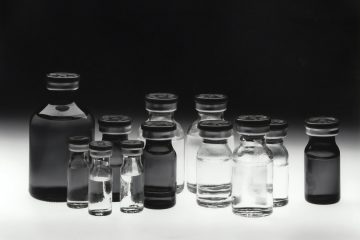
BPC-157 and TB-500 get discussed as alternatives to each other and they are not: BPC-157 is a fifteen amino acid fragment of a gastric protein studied mainly for its effects on blood vessels and the gut lining, and TB-500 is a fragment of thymosin beta-4, a protein whose main job is binding actin inside cells. Different biology, different papers, different forms.
The comparison is also more limited than the internet suggests, because no head-to-head human trial has ever compared the two, and TB-500 has no human clinical trial data at all. Anyone telling you one beats the other for a specific injury is going beyond what has been published. What can be compared is the evidence base, and that is what follows.
In This Guide
- Same shelf, different biology
- The head-to-head table
- What each has actually been studied for
- Where the comparison breaks down
- Regulatory and anti-doping status
- FAQ
Same shelf, different biology
TB-500 is a synthetic fragment of thymosin beta-4, a protein found in most cells. Its best understood function is actin sequestration: it binds the monomeric form of actin and holds it unpolymerised, which keeps a pool of raw material available for cells to reshape their cytoskeleton when they migrate, divide or respond to injury. The proposed reason it appears in wound healing research follows from that, since cell migration is the first step in tissue repair.
BPC-157 comes from a different starting point, a fragment of a protein in gastric juice, and its research profile centres on the nitric oxide system and on vascular growth signalling such as VEGF. The two mechanisms are not competing explanations of the same thing, which is why “which is stronger” is the wrong question and “what has each actually been shown to do, in which species” is the right one.
The head-to-head table
| BPC-157 | TB-500 (thymosin beta-4 fragment) | |
|---|---|---|
| Origin | Fragment of a protein found in human gastric juice | Synthetic fragment of thymosin beta-4, a naturally occurring cellular protein |
| Proposed main mechanism | Nitric oxide signalling and vascular growth factors | Actin sequestration, supporting cell migration and cytoskeletal remodelling |
| Half-life | Under 30 minutes in animals. No human figure published | Not established in humans at all |
| Forms studied | Injectable, with oral and rectal dosing in the bowel trials | Injectable in animal work |
| Human trial data | Phase II work in inflammatory bowel disease, early 2000s | None for TB-500 itself; the parent protein has human trial data in wound healing |
| Animal evidence | Extensive, more than 30 studies reviewed between 1993 and 2024 | Broad in preclinical models, and mapped in a 2026 scoping review |
| Approved for human use | No | No |
| Anti-doping status | Prohibited, named in WADA S0 | Prohibited as a non-approved substance |
| Flagged by the FDA for compounding | Yes, with immunogenicity and impurity concerns stated | Yes, the beta-4 fragment is listed with the same kind of concerns |
What each has actually been studied for
| Area | BPC-157 | TB-500 |
|---|---|---|
| Gut lining and inflammatory bowel disease | Human phase II data, the strongest human signal for either compound | Not the focus of the published work |
| Tendon and ligament | Animal models | Animal models, including work on tendon cell migration |
| Muscle injury | Animal models | Animal models |
| Skin and wound closure | Animal models | Preclinical models, with human trial data for the parent protein rather than the fragment |
| Nerve tissue | Animal models | Limited preclinical work |
| Heart and blood vessels | Animal models, consistent with the vascular mechanism | Preclinical work, including cardiac models |
| Strength or muscle growth in humans | Nothing published | Nothing published |
The pattern in that table is the honest summary of the pair. Both have real preclinical literature, neither has a human endpoint behind the claims that get made for it in gyms, and only one has any human trial data at all.
Where the comparison breaks down
- No head-to-head studies. Nobody has run a trial of one against the other, in any species. Every “X beats Y” claim is an inference from separate literatures.
- Different endpoints. The BPC-157 human data is about bowel inflammation. If the question is tendon healing, that data does not transfer, and the tendon evidence is animal data for both compounds.
- Different half-lives, both poorly characterised. One is under 30 minutes in animals, the other has no published human figure at all. Half-life does not predict effect duration in either case, for the reasons set out in our peptide half-life chart.
- Different purity risks. Both are unapproved, so the certificate of analysis and the batch matter more than the compound choice does.
- The parent protein is not the fragment. Thymosin beta-4 has human trial data in some wound settings. TB-500 is a fragment of it, and that data does not automatically apply to a different molecule with a different half-life.
Regulatory and anti-doping status
Neither compound is approved for human use by the FDA, the EMA or the MHRA. Both appear on the FDA’s page of bulk drug substances for use in compounding that may present significant safety risks, where the stated concerns for each are immunogenicity for certain routes of administration and the difficulty of characterising peptide impurities. Both are prohibited in sport: BPC-157 is named specifically in the WADA prohibited list under S0, the class for non-approved substances, and TB-500 is prohibited as a non-approved substance as well.
As with any research peptide, the practical question is not the label on the box but whether a batch-matched certificate of analysis exists, and whether the purity method and the peptide mass are stated. For the wider picture of categories and verification, see the guide to peptides, HGH and HCG and the other guides in the peptides section.
FAQ
Which is better, BPC-157 or TB-500?
No study has compared them head to head, in humans or in animals, so that question cannot be answered from the literature. What can be compared is the evidence base, and BPC-157 has more of it, including the only human trial data in the pair.
Do they work the same way?
No. TB-500 comes from thymosin beta-4 and its best understood function is binding actin to support cell migration. BPC-157’s research profile centres on nitric oxide signalling and vascular growth factors. Different mechanisms, different origins.
Are either of them approved for human use?
Neither. Neither is approved by the FDA, the EMA or the MHRA, and both are listed by the FDA among compounding substances that may present significant safety risks.
Does TB-500 have human trials?
Not for TB-500 itself. The parent protein, thymosin beta-4, has human trial data in some wound healing settings, and that is not the same molecule. TB-500 has no human clinical trial record of its own.
Would you stack them?
That is a question about using unapproved substances, and this page will not answer it. There is no human data on co-administration of either compound, with each other or with anything else, and no dosing information can be derived from animal studies.
Are they banned in sport?
Yes, both. BPC-157 is named explicitly in WADA’s S0 category of non-approved substances, and TB-500 is prohibited as a non-approved substance. An inadvertent positive test is a real risk for a competing athlete.
What is the half-life of each?
BPC-157 is under 30 minutes in animal studies, with no human figure published. TB-500 has no established human half-life at all. Neither number tells you how long the effect lasts.
Which one is safer?
Neither has a human safety database of the kind an approved medicine has, so a ranking is not available. Both carry the same class of regulatory concern about immunogenicity and impurities.
Last reviewed: October 2026 by Julian Hart. This page is educational and is not medical advice, and it is not an endorsement or an instruction for using any substance. Neither compound is approved for human use, and anything involving dosing or a health condition belongs with a qualified clinician.
Sources
- McGuire FP, et al. Thymosin beta-4 and TB-500 in tissue healing, regeneration and musculoskeletal research: a scoping review. 2026.
- Maar K, et al. Utilizing developmentally essential secreted peptides: thymosin beta-4 in organ regeneration and repair. 2021.
- Xing Y, et al. Progress on the function and application of thymosin beta-4, including human trial data for the parent protein. 2021.
- McGuire FP, et al. Emerging use of BPC-157 in orthopaedic sports medicine: a systematic review. 36 studies, 1993 to 2024.
- He L, et al. Pharmacokinetics … of BPC-157 in rats and dogs. 2022.
- FDA. Certain bulk drug substances for use in compounding that may present significant safety risks, listing both BPC-157 and the thymosin beta-4 fragment.
- WADA. The Prohibited List, S0 non-approved substances.
- ClinicalTrials.gov searches for BPC-157 and TB-500, for the registry record cited in this article.