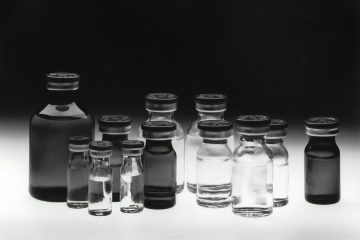
The published windows run from 14 days to 56 days, and which one applies to your vial depends on two things rather than on the compound: whether the water you mixed it with contained a preservative, and what the manufacturer validated. One growth hormone label allows 14 days after mixing with bacteriostatic water. Another allows 28 days with its own diluent. A pre-filled GLP-1 pen is good for 56 days once it is in use.
So the honest answer to “how long does it last” is: as long as your vial’s label says, refrigerated, protected from light, and never frozen. This page covers what those labels specify, why the numbers differ so much, and how to tell when a solution has gone past its window.
In This Guide
- The storage windows, from the labels
- Why the numbers are so different
- Temperature: fridge, freezer and the door shelf
- How to tell a solution has gone off
- A storage routine that removes the guesswork
- FAQ
The storage windows, from the labels
| Product or situation | Stated window | Conditions | Source |
|---|---|---|---|
| Somatropin reconstituted with bacteriostatic water | 14 days | Refrigerated at 2 to 8 degrees Celsius | Serostim prescribing information |
| Somatropin cartridge reconstituted with its own diluent | 28 days | Refrigerated at 2 to 8 degrees Celsius, do not leave at room temperature for more than about 30 minutes | Humatrope labeling |
| GLP-1 pen in use | 56 days | Refrigerated at 2 to 8 degrees Celsius or kept at 15 to 30 degrees Celsius | Ozempic prescribing information |
| Somatropin powder before reconstitution | Up to 3 months at room temperature | At or below 25 degrees Celsius, or refrigerated; do not freeze | Genotropin labeling |
| Lyophilised research peptide, no label statement | No published figure | Nothing to cite. Refrigerate, protect from light, and treat the window as unknown | Not established |
These are label figures for specific products, quoted to show the range that exists. They are not a general rule for any other compound, and they are not dosing guidance.
Why the numbers are so different
Three variables decide how long a mixed vial stays usable, and only one of them is about the peptide itself.
- Preservative or no preservative. Bacteriostatic water contains benzyl alcohol, which discourages bacterial growth and is what makes repeated withdrawals from one vial acceptable. Water for injection contains none, so a vial mixed with it is effectively single use and the window shortens.
- What the manufacturer validated. The 14 and 28 day figures above come from stability testing on those specific products, with those specific diluents. A number on a forum is not a validation, and it does not transfer from one product to another.
- The molecule itself. Peptides are vulnerable to hydrolysis and to aggregation, and the rate depends on the sequence. This is why some compounds hold up for weeks and others are visibly degraded within days, and why an unvalidated vial should be treated as short-lived.
That third point is the one people get wrong. A lyophilised vial is far more stable than the same peptide in solution, which is exactly why manufacturers ship powder and ask you to mix it shortly before use.
Temperature: fridge, freezer and the door shelf
| Where it sits | Temperature | What it does to a reconstituted vial |
|---|---|---|
| Freezer | Around minus 20 | Should not be used. Ice crystal formation damages peptide structure and labels explicitly say do not freeze reconstituted product |
| Fridge, middle or lower shelf | 2 to 8 | The correct place. Stable and even, and the standard storage condition in every label quoted above |
| Fridge door | 2 to 10, with swings | Avoid. Every opening changes the temperature, and repeated swings are harder on a solution than a steady cold |
| Room temperature | 15 to 25 | Acceptable only where a label says so. One pen product allows 15 to 30 for its in-use period; reconstituted vials generally do not |
| Warm room or car | Above 30 | Accelerated degradation. Treat a vial left in a hot car as lost, regardless of how long it was there |
Light is the other factor, and it is easy to forget because it does not show up on a thermometer. Protein solutions degrade faster under light, which is why labels say to protect from light and why the original carton is worth keeping. A vial standing on a sunny windowsill is not the same vial as one in its box at the back of a fridge.
How to tell a solution has gone off
Inspect before every draw, in good light, against a dark background if you can.
| What you see | What it means |
|---|---|
| Clear, colourless to faintly yellow, no particles | Normal for most reconstituted peptides |
| Cloudy, milky or hazy | Aggregation or microbial growth. Stop using it |
| Visible particles or floating specks | Undissolved material or contamination. Stop using it |
| Thick, gel-like or stringy consistency | Aggregation. Stop using it |
| A colour change beyond a faint yellow | Degradation or contamination. Stop using it |
| Particles that will not dissolve after gentle rolling | The peptide has come out of solution. Stop using it |
| Rubber stopper that looks punctured, torn or dirty | Contamination risk. Replace the vial |
A storage routine that removes the guesswork
- Write the date and the concentration on the vial the moment you mix it. Everything after that depends on those two facts, and memory is not a record. The arithmetic is covered in our reconstitution guide.
- Set your own expiry date and shorten it for an unlabelled vial. If the product has a stated window, use it. If it does not, pick a short one and stick to it rather than assuming months.
- Keep it in the box, in the middle of the fridge, standing upright. Not the door, not the freezer, not a shelf above something warm.
- Use a new needle and syringe for every draw. Health agencies are unambiguous on this: one needle, one syringe, and single-dose vials used once. It is the single biggest infection risk in this whole routine.
- Do not pre-load syringes for later. A vial is a controlled container with a validated window; a plastic syringe is not.
- Check before every draw. Ten seconds against a dark background catches everything in the table above.
- When in doubt, discard it. The cost of a vial is smaller than the cost of an infection, and there is no test you can run at home.
For how long each compound stays active once it is in circulation, rather than how long the vial keeps, see the peptide half-life chart. That page and this one answer two different questions, and conflating them is how people end up thinking a short half-life means a short shelf life. The other guides are collected in the peptides section.
FAQ
How long do reconstituted peptides last in the fridge?
Between 14 and 56 days depending on the product and the diluent, and only where the label states a figure. Reconstituted somatropin is the useful reference: 14 days with bacteriostatic water, 28 days with the manufacturer’s own diluent, refrigerated at 2 to 8 degrees Celsius.
Can I freeze a reconstituted vial to make it last longer?
No. Ice crystal formation damages peptide structure, and labels explicitly instruct against freezing reconstituted product. Freezing is for the lyophilised powder, and even then only where the label says so.
Does it have to be in the fridge door?
It should not be in the door at all. Every time the fridge opens the door shelf moves in temperature, and repeated swings are harder on a solution than a steady 2 to 8 degrees.
How do I know if it has gone bad?
Cloudiness, visible particles, a gel-like texture, a colour change beyond a faint yellow, or powder that will not dissolve after gentle rolling. Any of those means discard it. A clear, colourless to faintly yellow solution with no particles is normal.
What if it was left out overnight?
Treat it as compromised. A vial at room temperature outside its stated conditions has no validated window, and there is no way to test it at home. The safe answer is to discard it.
Does bacteriostatic water extend the shelf life?
It allows a vial to be drawn from repeatedly without the same bacterial growth risk, because of the benzyl alcohol, and it is the diluent used in the 14 day example above. It does not make the peptide itself more stable.
Should I warm the vial before drawing?
Letting it stand for a few minutes so it is not ice cold is a comfort question rather than a stability one. Do not heat it, and do not leave it lying in sunlight while you wait.
Can I store it in a syringe instead of the vial?
No. Draw immediately before use. The vial is the container with the validated window, and moving the solution into a plastic syringe restarts the clock on conditions nobody has tested.
Last reviewed: October 2026 by Julian Hart. This page is educational and is not medical advice, and it is not a set of instructions for using any substance. Where you are handling a prescribed medicine, its label and your clinician’s directions take precedence over everything here, and sharps should be disposed of properly.
Sources
- DailyMed (NIH). Humatrope (somatropin) labeling: reconstituted cartridges stable up to 28 days refrigerated at 2 to 8 degrees Celsius.
- Serostim (somatropin) prescribing information: reconstituted with bacteriostatic water, refrigerate at 2 to 8 degrees Celsius for up to 14 days.
- FDA. Ozempic (semaglutide) prescribing information: after first use, storage for 56 days at 15 to 30 degrees Celsius or refrigerated at 2 to 8 degrees Celsius.
- Genotropin (somatropin) labeling and patient information: before reconstitution, may be stored at room temperature at or below 25 degrees Celsius for up to 3 months; do not freeze.
- DailyMed (NIH). Bacteriostatic water for injection label: benzyl alcohol content and intended use as a diluent.
- CDC. Preventing unsafe injection practices: one needle and syringe per injection, single-dose vials used once.